A first-person documentary feature by Orly Yadin
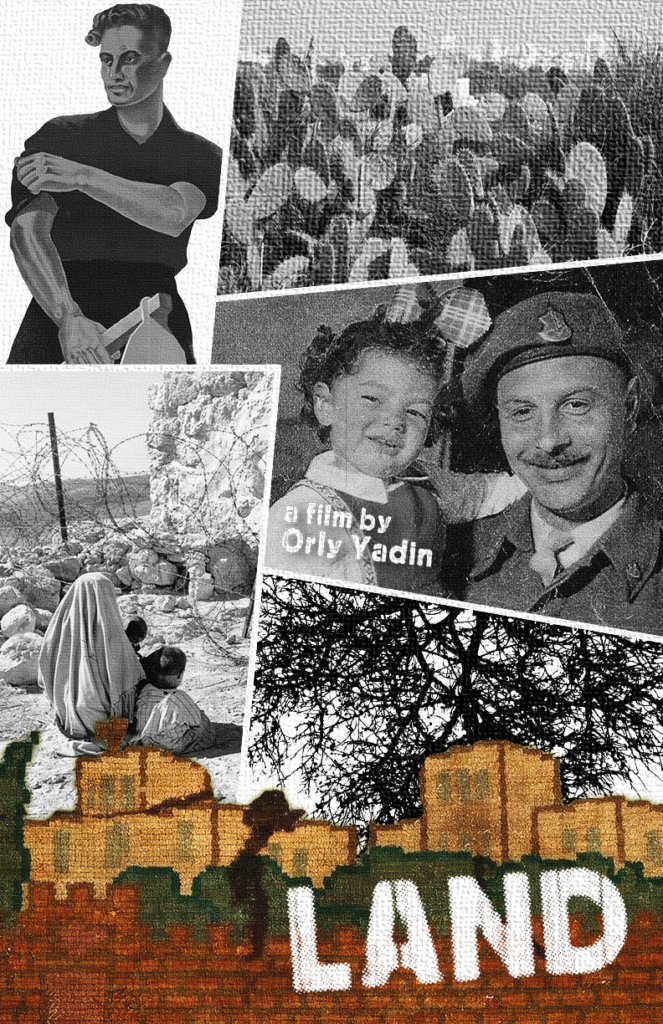
LAND: I Saw and I Didn’t See explores how national identity is constructed—and how it changes when the stories we inherit are questioned.
Born into a family of influential Zionist thinkers and archaeologists whose work helped shape the ideology of early Israel, the filmmaker sets out to examine the foundations of the worldview that defined her upbringing.
The film unfolds as a metaphorical archaeological excavation: digging through layers of family history, ideology, and memory. Archival home movies, photographs, and newsreels intersect with present-day conversations with Israelis and Palestinians. Animated sequences bring imagined encounters with the filmmaker’s ancestors to life, allowing the past to speak directly to the present.
As the excavation deepens, the film reveals the blind spots embedded in the national narrative that shaped an entire generation. LAND ultimately becomes both a personal reckoning and a broader reflection on how identities—personal and national—are formed, sustained, and transformed.
LAND is both a personal reckoning and a broader reflection on how national identities are built—and how they can change when we begin to see what was once invisible.
PRODUCTION
Producer/Director/Writer – Orly Yadin
Editor/Camera/Sound – Nora Jacobson
Original Score – Uri Agnon
Executive Producers – E. W. Stetson, Barbara Bordwell McGrew
Character Animator – Hayley Morris
Lip-Sync animator/compositor – Cody Millett
Motion Graphics – Ryan Dunleavy
FEATURING IN ORDER OF APPEARANCE
Rafi Greenberg
Nurit Peled-Elhanan
Noga Kadman
Nachman Ben-Yehuda
Mousa Ishaq
ANCESTOR VOICES
Marianne DiMascio
Eric St. John
Wayne Tetrick
Baa Baa Blacksheep song
performed by
Lorelei Bernatt Hughes
MUSICIANS
Uri Agnon
Omri Kochavi
Alice Purton
Olly Sellwood
Narration Recordist
Joe Egan
Assistant Sound Recordist
Meghan O’Rourke
Additional camera
Dan Higgins
Eleanor Lanahan
Orly Yadin
POST PRODUCTION
Sound Mixer
Max Johnson
Dialog Editor
Joe Egan
Color Grader
Art Bell
Music Mixer
Dan Erlich
Additional sound work
Charles Geoghegan
Studio facilities
Egan Media
Media Factory
Strongroom Ltd.
Film/Video Transfers
The Edit Store
VideoSyncracies
ARCHIVAL SOURCES
BibleWalks.com
British Pathé
Central Zionist Archive
Natasha Dudinski
Oren Feld
Footage Farm Ltd.
Free Jerusalem
Herzliya Studios
Israel Film Archive/
Jerusalem Cinematheque/
State Archive
Israfilm Collection / Sadot North
ITN
Noga Kadman – Zochrot
Gabi Klezmer
Library of Congress
NBC
PalestineRemembered.com
Reuters Screenocean
Spielberg Jewish Film Archive
tv.social.org.il
WYSInfo.com
Ruppin/Yadin Family home movies
Ibrahim Zarour
Morning Song
written by Natan Alterman,
performed by Effi Netzer Singers
FILMING LOCATIONS
Israel, Palestine, USA
*********
Thanks to all the amazing supporters who made this production possible
PRODUCTION/POST PRODUCTION SUPPORTERS:
E. W. Stetson (Executive Producer)
Barbara Bordwell McGrew (Executive Producer)
Frank & Ducky Donath
Robin Lloyd
Mannie Lionni
Kevin Meehan
Lisa Schamberg & Pat Robins
Nat Winthrop
Gretchen Santamour & Brian Ortelere
Liora Alschuler
Patricia Fontaine
Jane & Rain Kramer
Kate Robinson Schubart
The Stern Foundation
Serrill Flash
Bob Green & Billy Coil
PROMOTION AND OUTREACH SUPPORTERS
Jessica Arendt, Anne Barbano, Gene Bergman, Margaret Berlin, Anna Blackmer, Lauren-Glenn Davitian, Bob Duncan, Charlie & Diane Gottlieb,
Kimberly Janson, Ali Johnson, Barbara Jorrisch, Larry Kardish, Andy Kolovos,
Rena Koopman, Larry Krasner, Arnie Malina, Phyllis Mazurski,
Bridget & Nick Meyer, Muffie Olivia Milens,
Patricia Mizutani & Richie Rosenhaft , Ann Moore, Barbara Murphy,
Sherrill Musty, Oliver O’Sullivan, Pamela Poulston, Jennifer Rangnow,
Judy Raven & Lee Suskin, Gay Regan, Anne Roland, John J. Santamour,
David Schein, Kathleen Schneider, Magali & Mike Simon-Martin,
Gail Stevenson, Stephanie Stewart & Ron Mogel, Dorothy Tod,
Steven Wisbaum, Suzi Wisowaty, Joyce Wong & Chad Hansen,
Marj & Orv Wright, Laura Zakaras
THANKS TO
Batsheva Stein (woman on plane)
Alaa & Amal Sumrin (of Silwan)
FOR AGREEING TO BE IN THE FILM
FOR NOT AGREEING
BUT ENCOURAGING NONETHELESS
Raef Zreik
FOR HER GENEROUS FEEDBACK
Nora Jacobson
FOR THEIR INVALUABLE ADVICE
Uri Agnon, Yuli Cohen, Chad Erwin
Gali Gold, Tamar Goldschmidt
John Killacky, Kate Schubart,
Bob Summers, Littal Yadin
And to The Casual Chatters –
Tony Dowmunt, Gilly Lacey, Ian Sellar –
for not letting me give up for over 20 years